- Lifestyle
Floriano Francesconi and the Origins of the World’s Oldest Café

St. Mark’s Square would not be the same without Caffè Florian, but Florian would never have existed without the brilliant intuition of its founder. In 1720, Floriano Francesconi opened the doors of “Alla Venezia Trionfante“, a venue destined to change the history of the city and the habits of its citizens.
From a simple coffee shop to the hub of European intellectual life, we trace the life and vision of the man who gave his name to the oldest historic café in the world, creating a legacy that remains intact today.
Venice in 1720 and the Brilliant Intuition of Floriano Francesconi
In early 18th-century Venice — a lively, cosmopolitan city pulsing with cultural fervor — St. Mark’s Square was the beating heart of public life. Francesconi sensed the immense potential of the location and leased a space under the Procuratie Nuove from the Procurators of St. Mark. The premises were modest, consisting of just two rooms (what are now the entrance and the Senate Room), but the location was strategic.
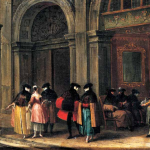
Painting by Francesco Guardi, Masked men drinking coffee at the Florian.
His goal was to launch the coffeehouse to coincide with the opening of Carnival on December 26, when the square’s famous liston filled with costumed revelers, nobles, and visitors. However, a delay in carpentry work forced Francesconi to postpone the opening by three days. The doors finally swung open on December 29, 1720, welcoming its first patrons seeking refuge from the winter cold and a hot drink.
Alla Venezia Trionfante: The First Name of a True Legend
“Alla Venezia Trionfante” (Triumphant Venice) was the name chosen by Floriano Francesconi for his shop — a proud, yet wistful choice. In 1720, the Serenissima Republic was gradually losing its former political and economic sway, and that nod to “triumph” struck a somewhat melancholic chord with locals.
The Florian sign above the entrance at the Coffeehouse in St. Mark's Square.
What truly changed the course of history was the affection the patrons felt for the owner. In everyday conversation, locals formed the habit of simply saying: «Andemo da Florian!» (“Let’s go to Florian’s!”). The drop of the final vowel, typical of the Venetian dialect, transformed Floriano into “Florian“.
Before long, the official name remained confined to property registries, giving way to the name by which the world would know it forever.
The Evolution from a Coffee Shop to a Prestigious Literary Salon
In its early years, Florian looked quite different from the grand café we know today. The original two rooms were sparsely furnished and exposed to the elements, lacking the glass windows that insulate the interior today.
Chronicles of the era describe patrons wrapped in heavy wool capes (tabarri) with tricorn hats perched on their heads, sipping coffee with their feet resting on the snow and brass hand-warmers in their hands. As warmer weather arrived, Francesconi had another stroke of genius: placing tables and chairs directly on the square, creating the city’s very first open-air salon.
Success was immediate. Around 1750, the café expanded with two additional spaces, today known as the Chinese Room and the Oriental Room.

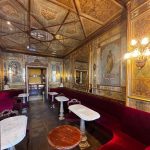
From that moment on, Florian ceased to be a mere place for refreshments or gambling, transforming into a hub for social and cultural observation. It was while seated at these very tables in 1760 that Count Gasparo Gozzi conceived the Gazzetta Veneta, one of the earliest examples of modern journalism in Italy. Later, in 1893, inside the Senate Room, Mayor Riccardo Selvatico and a group of intellectual friends formulated the idea for an international art exhibition, an event that would soon gain worldwide renown as the Venice Biennale.
Welcoming Intellectuals and Illustrious Figures of the Era
“Where else outside this place could it be so wonderful to simply let life happen! Step across this unique wooden threshold inlaid with marble tiles, leading you into the most exquisite remaining monument dedicated to the glory of the city—immortalized by Goldoni, Vivaldi, Tiepolo, Longhi, Canaletto, and Guardi. The doors open to a universe of beauty that miraculously coexists in today’s Venice, continuing to pass on a lifestyle and a joy of living inspired by the sweetest nostalgia.”
With these words, the poet and writer Henri de Régnier captured the deep essence of Florian: not just a place to stop for coffee, but a privileged vantage point from which to observe, meet, and immerse oneself in Venetian life.
From its inception, the café established itself as an indispensable landmark for international culture, drawing enlightened minds, artists, and high-society figures. Renowned historical figures found refuge and inspiration within its rooms: from Giacomo Casanova—who favored it for his romantic rendezvous, helped by the fact that Florian was the only café of its era to admit women—to the great masters of literature and art. Lord Byron, Percy Bysshe Shelley, Charles Dickens, Johann Wolfgang von Goethe and Ernest Hemingway all sat at these tables, alongside legendary composers like Giuseppe Verdi and Richard Wagner.
The Café’s Deep Connection with the History of the Serenissima
There is a detail that instantly underscores the enduring bond between Florian and Venice: the Lion of St. Mark. The winged lion, the everlasting symbol of the Serenissima, greets visitors in the precious mosaic at the entrance and recurs elegantly across Florian-branded creations, from fine porcelain to special historical packaging.
It is far more than a decorative touch; it is the common thread tying the Coffehouse to its native city. For over three centuries, Florian has been both a silent witness to and an active participant in Venetian life, enduring the fall of the Republic, the political upheavals of the 19th century, and the social transformations that reshaped the city throughout the 20th century.
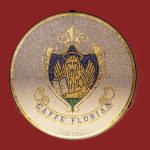
Mosaic with a winged lion, symbol of the historic bond between the Florian and the lagoon city.
Preserving History in St. Mark’s Square as Floriano’s Legacy
To fully appreciate what Floriano Francesconi built, one only needs to look at how the café was described back in the 19th century. Around 1836, Honoré de Balzac was fascinated by its extraordinary versatility, describing it simultaneously as a stock exchange, a theater foyer, a reading room, a private club, and even a confessional. It was, in other words, a vibrant space where remarkably diverse people, ideas, and human stories collided.
This is Francesconi’s greatest legacy: he didn’t just open a coffee shop; he created a dynamic hub capable of evolving alongside the city and echoing its transformations over time. Today, stepping across the threshold of Florian means sitting in the very rooms that have welcomed generations of Venetians and travelers from every corner of the globe. Though the décor has expanded over time and habits have inevitably changed, its founding mission remains untouched: to offer everyone who enters a front-row seat to Venice, allowing them to discover the city and feel, even for a moment, like an integral part of its story.
Frequently Asked Questions about Florian
Who founded Caffè Florian?
Caffè Florian was founded by Floriano Francesconi, who opened the coffeehouse under the original name Venezia Trionfante.
What is the oldest cafe in Venice?
Caffè Florian is the oldest Coffeehouse in Venice — and the entire world — operating continuously in St. Mark’s Square since its opening.
Why is it called Caffè Florian?
Local Venetian patrons routinely said «Andemo da Florian!» (“Let’s go to Florian’s!”), shortening his name in dialect, which eventually stuck as the permanent title.
When was Caffè Florian established?
It was established on December 29, 1720.

