- Gourmet
Traditional Venetian Carnival sweets between history, flavours and curiosities
The Venetian Carnival is one of Europe’s most fascinating celebrations, a vibrant blend of masks, music and rituals deeply rooted in the history of the Serenissima.
Alongside costumes and public festivities, traditional Venetian Carnival sweets have always played a central role, becoming symbols of abundance, conviviality and freedom.
Prepared in private homes, artisan bakeries and served in historic cafés, these sweets tell the story of a cultured and indulgent Venice, where culinary pleasure naturally blends with history and the art of living.
The Venetian Carnival between popular celebration and food culture
First and foremost, the Venice Carnival is a great popular celebration, filled with masks, music, encounters and an atmosphere seemingly suspended in time. The narrow streets come alive, squares turn into open-air stages, and the entire city is wrapped in a sense of wonder and light-hearted freedom that permeates everyday life.
In this festive setting, food naturally takes centre stage and becomes an essential part of the experience. One cannot speak of Carnival without mentioning frittelle and galani, the quintessential Carnival sweets in Venice. Made with simple ingredients and traditional methods, they are designed to be shared, combining aromas, textures and memories.
Tasting them means stepping into the very heart of the celebration, where flavour and festivity meet in the most authentic way.


Venetian frittelle as the symbolic Carnival sweet
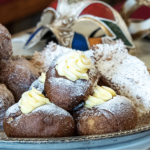
Among all the traditional Carnival sweets of Venice, Venetian frittelle, known locally as fritoe, are undoubtedly the true protagonists.
Soft, golden and fragrant, they are made from a simple dough of flour, eggs, milk, sugar and baker’s yeast, enriched with soaked raisins and pine nuts that define their unmistakable character. In their most authentic version, Venetian frittelle are traditionally unfilled, remaining faithful to a recipe that has been passed down through centuries.
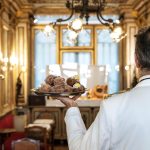
Frittelle served at Florian according to the original recipe.
Do you know how far back their origins go?
Their history dates to the 16th century, when frittelle were prepared by the fritoleri, professional sweet-makers organised into a recognised guild. They could be found along the calli and in Venice’s squares, frying frittelle on the spot and selling them with a small flask of red wine, turning a simple treat into a convivial and popular ritual.
Alongside the classic version, today there are many variations that reinterpret frittelle in a more indulgent way: filled with custard, chocolate or zabaglione, or enriched with apple pieces or a soft pistachio cream. Each variation adds a new nuance, without ever betraying the original spirit of this beloved Carnival dessert, which still evokes the shared joy of the celebration.
Galani and crostoli between lightness and crunch
Galani in Venice, crostoli on the mainland and in Friuli, chiacchiere in Lombardia and Emilia-Romagna, bugie in Liguria and Piemonte, cenci in Toscana, frappe in Lazio.
Names change from region to region, but they all refer to the same beloved Italian Carnival treat. Thin, crisp and airy, these fried pastries represent a shared tradition that unites Italy in the spirit of celebration.
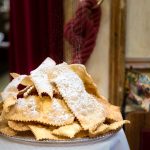
Galani, traditionally served at Florian's on the Carnival plate.
In Venice, galani are considered the most elegant expression of this dessert. Their elongated shape, extreme crispness and light dusting of powdered sugar make them a symbol of refinement and delicacy, perfectly in tune with the lagoon city’s aesthetic and atmosphere. Known elsewhere as Venetian crostoli, they remain an essential presence among Carnival sweets.
Sugar, spices and Eastern influences
This Carnival pastry tradition, like Venetian confectionery as a whole, has been profoundly shaped by Venice’s historic trade with the East. Sugar, spices and exotic aromas gradually enriched local recipes, making them more complex and fragrant.
These influences are still evident today in warm, enveloping flavours and in the use of raisins, citrus peels and aromatic notes that evoke distant journeys. It is a legacy Venice continues to preserve, turning each dessert into a small yet meaningful expression of its mercantile and cultural history.
Caffè Florian and the Venetian sweet tradition
During the Carnival season, Caffè Florian renews its bond with Venetian pastry tradition by offering a special Carnival platter that celebrates the most authentic flavours of the festival.
An assortment that brings together galani and frittelle in two interpretations: a classic Venetian fritter with raisins and pine nuts, and a cream-filled version for those who enjoy a more indulgent touch. A perfect balance between tradition and contemporary pleasure, to be savoured while watching Carnival unfold in St. Mark’s Square.

Florian's recipe book contains the secrets to making Carnival desserts, and more, at home.
For those who wish to take the flavours and aromas of Carnival home, Florian also shares its original recipes in the cookbook “Caffè Florian Delicacies“.
More than a collection of frittelle and galani, this volume preserves a wider pastry heritage, including esse, baicoli, zaeti, croccante and caramei, sweets enjoyed throughout the year. It also features seasonal specialties such as crema fritta and the San Martino cake, reflecting a living tradition that follows the rhythm of the seasons and festivities.


A story of sugar, memory and craftsmanship that, at Caffè Florian, continues to evolve without ever losing sight of its roots.
Carnival sweets as cultural heritage
As this journey shows, Venetian Carnival sweets belong to much more than the festive sphere alone. They are part of a broader gastronomic heritage that still defines lagoon culture today. They appear in family memories, in the windows of historic pastry shops and on the menus of the city’s most iconic venues, where tradition continues to engage in dialogue with the present.
These Carnival sweets in Venice have the power to evoke emotions, images and shared memories, transforming a simple taste into a meaningful and enduring experience.


