- Art
- Events
National Day of Historic Places in Italy

Discovering the Historic Places of Italy that Tell Stories of Taste and Tradition
The National Day of Historic Places in Italy is an event held every year on the first Saturday of October.
It is dedicated to promoting the historical and cultural heritage represented by the oldest and most prestigious hotels, restaurants, pastry shops, and literary Cafes in Italy, defined as “historic” for having preserved the traces of the passage of time, safeguarding the memory of Italian history.
These places have managed to remain operational and attractive to contemporary society, demonstrating a far-sighted, stoic, and resilient practice through the ups and downs of history.
Among these historic places, Caffè Florian stands as a symbol of Venice’s enduring charm. Founded in 1720, this iconic establishment has witnessed centuries of history. To learn more, you can discover the rich history of one of Europe’s oldest cafés.
Over the years, Caffè Florian has been more than just a café; it has been a centre of artistic and cultural activity. Its connection to Venice’s artistic movements is undeniable. Explore the connection between Caffè Florian and Venetian art to dive deeper into its cultural significance.
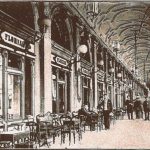
Postcard from the early 1900s
The Purpose of the Day and the Events
The initiative was born from the Association of Historic Places in Italy, a cultural association that brings together about two hundred places that have played a significant role in Italy’s history, either by promoting events or by being frequented by illustrious personalities. Historic places are precious treasures that jealously guard the spirit and soul of past generations.
In every region from north to south, it is possible to participate in organized initiatives: guided tours, tastings, for a single widespread event throughout the national territory.


Historical and Artistic Heritage of Caffè Florian
Welcome to the heart of History.
Sitting on the red sofas that once hosted illustrious and common citizens alike, the magic of the vertigo of time is renewed.
Since 1720, Caffè Florian has been a place where customers are served with a spirit of hospitality that has remained unchanged over time. Joyful spirits found here an international environment that blended with the warmth of Venetian culture, even the most genuine and straightforward.
Sensuality and literature, popular wisdom and Enlightenment philosophy: a rich humus of cultural ferment has been the driving force to lead Florian to navigate calm seas triumphantly and sail through stormy ones unscathed.

Carrara marble tables and cryptic decorations by Giacomo Casa in the Women’s Room.
The Caffè has always been at the centre of movements for change: under the Republic of Venice, it followed the Venetian domination of the sea and then the land; it hosted the Venetian discontent during the Austrian domination; it welcomed the sculptor Canova, a friend of the Francesconi family, who represented beauty in a neoclassical key, while Napoleon changed the face of the city, making it abandon its medieval aspect. And once again, under the aegis of a unified national idea, Florian gave refuge to those who wanted to write a new page in history.
A beacon, a point of reference in Venice, in Europe, and the world: a place to rediscover one’s roots and a sense of identity for the cosmopolitan community that inhabited Venice.
The comfort of a living room, a showcase on the world, the coveted dream for many.
Its lit lamps in the Galleria delle Procuratie Nuove have symbolized the continuity and reliability of the place that represents the strength of a tenacious Venice that resists, wins, loses, surrenders, rises, and starts again.

Viva Verdi, the motto linked to the Risorgimento
From “At the triumphant Venice”, as Floriano Francesconi decided to call it in honour of the city that dominated the Adriatic, to “Florian”, as it was affectionately called by its patrons in reference to the owner’s name, the Caffè Florian has crossed three centuries, leaving behind the aristocrats of the oligarchic republic, passing through Austrian and then French domination, transforming itself at the stage of revolutionary movements.
It was using a chair and a table from Caffè Florian that Daniele Manin proclaimed the independence of the Republic of San Marco on March 22, 1848.
Piazza San Marco was crowded with cheering patriots, and Manin, just released from prison, took charge:

Daniele Manin proclaims the Republic of San Marco standing on a table at Florian
«Citizens!
I see in your faces that the senses of love of country and national spirit have made here, during my imprisonment, great progress, I enjoy it highly and in the name of the homeland I thank you. But come on! Do not forget that there can be no true and lasting freedom, where there is no order, and that you must be jealous of the order, if you want to show yourself worthy of freedom. There are solemn moments and cases in which insurrection is not only a right, but also a duty»
(Daniele Manin after the people’s liberation on March 17, 1848)

Carrara marble tables dating back to 1858. Stucco and decorations are the work of the best craftsmen of the time
Art and Architecture: A Timeless Venetian Jewel
Furnished with Carrara marble tables that rotate so that ladies – in the past dressed in crinolines – could sit on the sofas, and decorated by artists from the Academy of Fine Arts under the direction of the architect Lodovico Cadorin, the rooms of Florian have been preserved intact, restored and constantly maintained since 1858.
To keep up with new service needs without ever losing their nature as an example of a masterpiece of art and architecture.
A living museum in time: the beauty of historical places lies in their ability to be ancient, authentic, true to themselves, but never outdated.
The first place to guarantee freedom of expression: it was chosen as the seat of the editorial and distribution office of the “Gazzetta Veneta”.
The first and only place in the city to guarantee equality between the sexes: it had a room dedicated to welcoming women, while all other cafés prohibited their entry (edict of 1776).
Caffè Florian broke down the barriers between social classes: it brought together members of patrician families and ordinary citizens to share common spaces and the ritual of coffee.
“Andemo da Florian”: going to the Caffé became a democratic moment in city life: an agorà where brilliant minds and gossip fomenters – (and how many love intrigues!) – laid the foundations of Venice’s history.


Guided tour of the Florian Coffee Halls
The 2024 edition will offer the opportunity to be accompanied on a historical tour of the rooms of Florian.
The visit includes explanations and historical anecdotes related to the decorations of the rooms: Senate, Chinese, Oriental, Illustrious Men, and Seasons.
Behind every detail of Caffè Florian, there is a constant commitment and dedication that have been passed down for centuries. The families that have managed this historic Café have always worked with passion to preserve its essence and offer visitors an unforgettable experience.
The National Day of Historic Places is an opportunity to recognize and celebrate this commitment.


